Archery Blog
Compound Bow Guide: Complete Beginner’s Manual for 2026
Apr
If you’re stepping into the world of archery, choosing your first compound bow can feel overwhelming. Cams, let-off, draw weight, axle-to-axle length — there’s a vocabulary all its own, and the wrong setup can make the sport miserable before you ever launch your first arrow. This compound bow guide cuts through the marketing noise and walks you through everything you actually need to know: how a compound bow works, how to size one to your body, how to tune it, and which bows are worth your money in 2026.
Whether you’re a hunter looking for a hard-hitting rig for whitetail season or a target archer chasing tight groups at 50 yards, the fundamentals are the same. Get those right and the rest is just practice.
What Is a Compound Bow and Why Choose One?
A compound bow uses a system of pulleys (called cams) and cables to bend its limbs and store energy. Unlike a recurve or longbow, where you’re holding the entire draw weight at full draw, a compound bow has let-off — typically 75% to 90% — meaning at full draw you’re only holding 6 to 14 pounds even on a 60-pound bow. That’s a game-changer for accuracy because you can hold steady on the target while you settle your aim.
Compound bows also shoot flatter and faster than traditional bows. Modern flagship models routinely hit IBO speeds of 340 to 350 feet per second, which translates to less arrow drop, more forgiving range estimation, and harder-hitting impact for hunting. The trade-off is mechanical complexity — more parts that can go out of tune — but with basic care, a quality compound will serve you for a decade or more.
Compound Bow vs Recurve: Which Is Right for You?
- Choose compound if you want maximum accuracy, plan to hunt big game, or shoot at longer distances.
- Choose recurve if you want to shoot Olympic-style target, prefer instinctive shooting, or want a simpler, quieter rig.
Most new archers in North America go compound, and that’s what this guide focuses on.

Anatomy of a Compound Bow
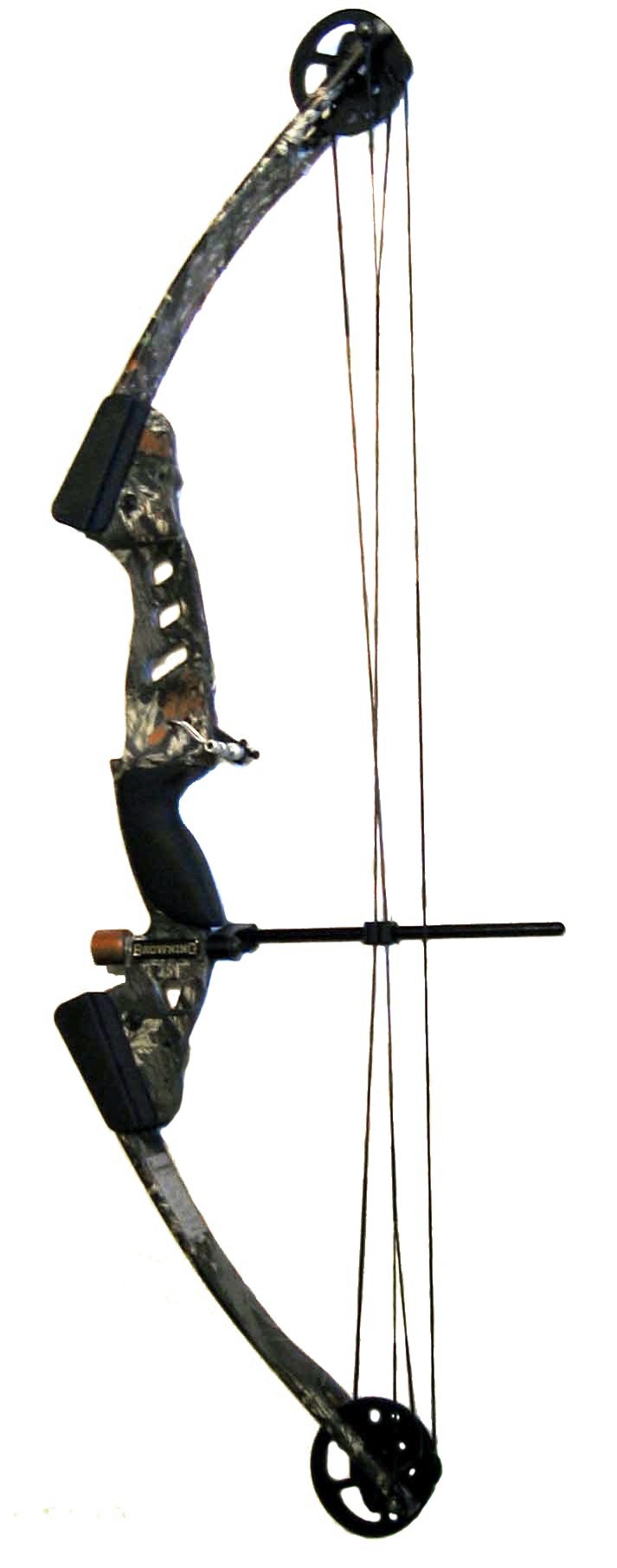
Before you can shop intelligently, you need to know what you’re looking at. Here are the parts of a compound bow you’ll hear about constantly:
- Riser — The center frame, usually machined aluminum or carbon. Stiffness here translates to accuracy.
- Limbs — The flexible upper and lower arms that store energy when you draw.
- Cams — The eccentric wheels at the ends of the limbs. Single, hybrid, twin, and binary cam systems all exist; binary cams (most common today) self-correct for cam lean.
- Bowstring and cables — The string carries the arrow; cables connect the cams.
- Cable guard and slide/roller — Pulls the cables out of the path of the arrow.
- Grip — Where your bow hand rests. A consistent grip is the foundation of accuracy.
- Berger holes — Threaded mounting points on the riser for arrow rests.
- Brace height — Distance from the grip to the string at rest. Longer brace = more forgiving, shorter brace = faster.
- Axle-to-axle length (ATA) — Distance between the cam axles. Shorter is better for treestand hunting, longer is better for target.
Draw Length and Draw Weight: The Two Numbers That Matter Most
If you get nothing else right, get these two right.
Finding Your Draw Length
Draw length is the distance from the bowstring at full draw back to the throat of the grip. Shooting a bow set to the wrong draw length will wreck your form and your groups. The quick formula:
Draw length (inches) = wingspan ÷ 2.5
Stand with your arms outstretched, palms forward. Measure fingertip to fingertip in inches and divide by 2.5. A 70-inch wingspan gives you a 28-inch draw length, which happens to be the most common size sold. Get it confirmed at a pro shop before you buy — most modern compounds adjust in half-inch increments via the cam module.
Choosing Draw Weight
Draw weight is the peak force, in pounds, required to pull the bow to full draw. Don’t ego-shop here. Pick a weight you can pull smoothly while seated, with the bow held parallel to the ground — if you can’t, you’re overbowed.
General guidelines:
- Whitetail and similar-sized game: 40–50 lbs minimum (most states require 40 lbs)
- Elk, moose, large game: 55–70 lbs
- Target shooting: 40–55 lbs (lighter weights = better endurance, less fatigue)
Most adult bows adjust across a 10–15 pound range, so you can start lower and work up as your shooting muscles develop.

Best Compound Bows for 2026 by Use Case
Best for Beginners: Bear Archery Cruzer G2
The Cruzer G2 is the bow most pro shops recommend to first-time buyers, and for good reason. It adjusts from 12 to 30 inches of draw length and 5 to 70 pounds of draw weight using only an Allen wrench — meaning a 10-year-old and their adult-size parent can share the same bow. It comes ready-to-shoot with a sight, rest, quiver, stabilizer, and peep already installed. At around $400 with the kit, it’s the highest-value entry-level rig on the market.
Best for Hunting: Hoyt RX-9 / Mathews Phase4
If you’re hunting and budget allows, flagship hunting rigs from Hoyt or Mathews deliver near-silent shots, vibration-free release, and IBO speeds in the 340+ FPS range. Both are short ATA (29–33 inches) for treestand maneuverability.
Best for Target: Mathews TRX 38 / Hoyt Stratos
Long ATA (38 inches), heavy mass, and tuned for absolute accuracy. These aren’t hunting bows — they’re built to win 3D and indoor tournaments.

Essential Compound Bow Accessories
A bare bow is unshootable. Budget for the following on top of the bow itself:
- Arrow rest — A drop-away rest like the QAD UltraRest is the gold standard.
- Sight — Single-pin slider sights for hunting (HHA Optimizer) or multi-pin (Black Gold) for ranges out to 60 yards.
- Stabilizer — 6–10 inches for hunting, 30+ inches for target.
- Release aid — Index-finger release for hunters, thumb or hinge release for target.
- Quiver — Detachable hip or bow-mounted.
- Peep sight — Tied into the bowstring; gives you a rear sight reference.
- D-loop — A small loop of cord on the string where you attach the release.
- Arrows — Carbon arrows spined to your draw weight and length. Don’t cheap out here — undersized arrows can fail catastrophically.


How to Tune Your Compound Bow
A new bow off the shelf is rarely tuned to you. Tuning ensures your arrows leave the bow straight, with no fishtailing or porpoising. The basic tuning sequence:
1. Set Center Shot
Use a laser or string to align the arrow rest so the arrow points down the center of the bow.
2. Paper Tune
Shoot through a sheet of paper at 6 feet. A perfect tear is a clean hole with three small fletching slits — a bullet hole. Tail-high or tail-low tears mean the rest needs vertical adjustment; left or right tears mean horizontal adjustment.
3. Walk-Back Tune
Shoot at a single vertical line at 10, 20, 30, and 40 yards. If the arrows track straight down the line, your sight is correctly windaged.
4. Bare Shaft Tune
Shoot a fletched arrow next to a bare (un-fletched) shaft at 20 yards. They should hit close together. Drift means rest or spine adjustments are needed.
For a visual walkthrough, watch the top YouTube tutorial on compound bow tuning:
Shooting Form Fundamentals
The best bow in the world won’t compensate for poor form. Drill these basics until they’re automatic:
- Stance — Feet shoulder-width, perpendicular to the target.
- Grip — Relax your bow hand. Pressure should be on the meaty pad below your thumb. A loose, open hand prevents torque.
- Anchor point — A consistent reference where the string touches your face every shot. Most archers use the corner of the mouth and tip of the nose.
- Back tension — Pull through the shot using your back muscles, not your fingers.
- Follow-through — Don’t drop the bow. Hold position until the arrow hits.
Maintenance and Care
A compound bow is a precision instrument. Care for it accordingly:
- Wax the bowstring every few weeks of shooting. Frayed strings cause failures.
- Inspect cams and cables before each session for wear or twist.
- Replace strings every 2–3 years or after roughly 5,000 shots.
- Store the bow upright, out of direct sunlight and away from extreme heat (no car trunks in summer).
- Have it pressed and serviced annually at a pro shop.
Common Beginner Mistakes
- Buying too much draw weight. If you can’t draw smoothly with one fluid motion, drop the weight.
- Skipping the pro shop fitting. A free 15-minute setup at your local shop saves months of frustration.
- Using cheap arrows. Wrong-spine or damaged arrows are dangerous and inaccurate.
- Death-gripping the bow. Use a wrist sling and let the bow rock forward in your relaxed hand.
- Not practicing at hunting distances. If you’ll shoot a deer at 30 yards, practice at 40+.
Final Thoughts
A compound bow is one of the most rewarding tools in the outdoor world. It demands precision, repetition, and patience — and it pays you back with skills that last a lifetime. Start with the right size rig, tune it properly, drill your form, and shoot every week. Within a season, you’ll go from struggling to keep arrows on a paper plate at 20 yards to landing tight groups at 40. Within a few seasons, you’ll have the confidence to take ethical shots in the field or compete at your local 3D shoot.
The gear matters, but consistency matters more. Pick a bow you can grow with, learn it inside and out, and put in the reps. Welcome to archery.
Sources
- Archery Trade Association — Industry standards and IBO speed ratings
- Bowhunter Magazine — Hunting bow reviews and field tests
- USA Archery — Coaching and form fundamentals
- Bear Archery — Cruzer G2 specifications
- Mathews Archery — Flagship compound bow lineup
- Hoyt Archery — Hunting and target compound specifications
