Archery Blog
Compound Bow Guide: How to Choose, Set Up, and Shoot Your First Compound Bow in 2026

Apr
If you’re stepping into the world of archery in 2026, the compound bow is the most popular and forgiving choice on the market — and for good reason. With its system of cams, cables, and let-off, a modern compound bow lets you hold heavier draw weights at full draw with a fraction of the effort, deliver arrows at blistering speeds, and shoot tighter groups than almost any other bow style. This compound bow guide breaks down everything you need to know before you buy, from anatomy and fit to setup, tuning, and the accessories that actually matter.
What Is a Compound Bow?
A compound bow is a modern bow that uses a levering system of cams (or wheels) and cables to bend the limbs and store energy. Unlike a recurve or longbow, the energy stored doesn’t increase linearly through the draw cycle. Instead, the cams give you a peak weight in the middle of the draw and then drop off sharply at full draw — a phenomenon called let-off, typically 75% to 90% on modern bows.
That means if you’re shooting a 70-pound compound with 85% let-off, you’re only holding about 10.5 pounds at full draw. You can settle into your aim, control your breathing, and execute a clean shot without your bow arm shaking from fatigue. This is the single biggest reason compound bows dominate bowhunting and target archery worldwide.
Compound Bow vs. Recurve vs. Longbow
- Compound: Cam-driven, high let-off, fastest arrow speeds (300–350+ FPS), highly accurate, most accessory-friendly.
- Recurve: Curved limbs, no let-off, used in Olympic archery, simpler and lighter.
- Longbow: Traditional D-shaped, no let-off, instinctive shooting, beautiful but demanding.
If your goal is hunting, 3D archery, or hitting tight groups at 40+ yards with the shortest learning curve, the compound bow is the answer.
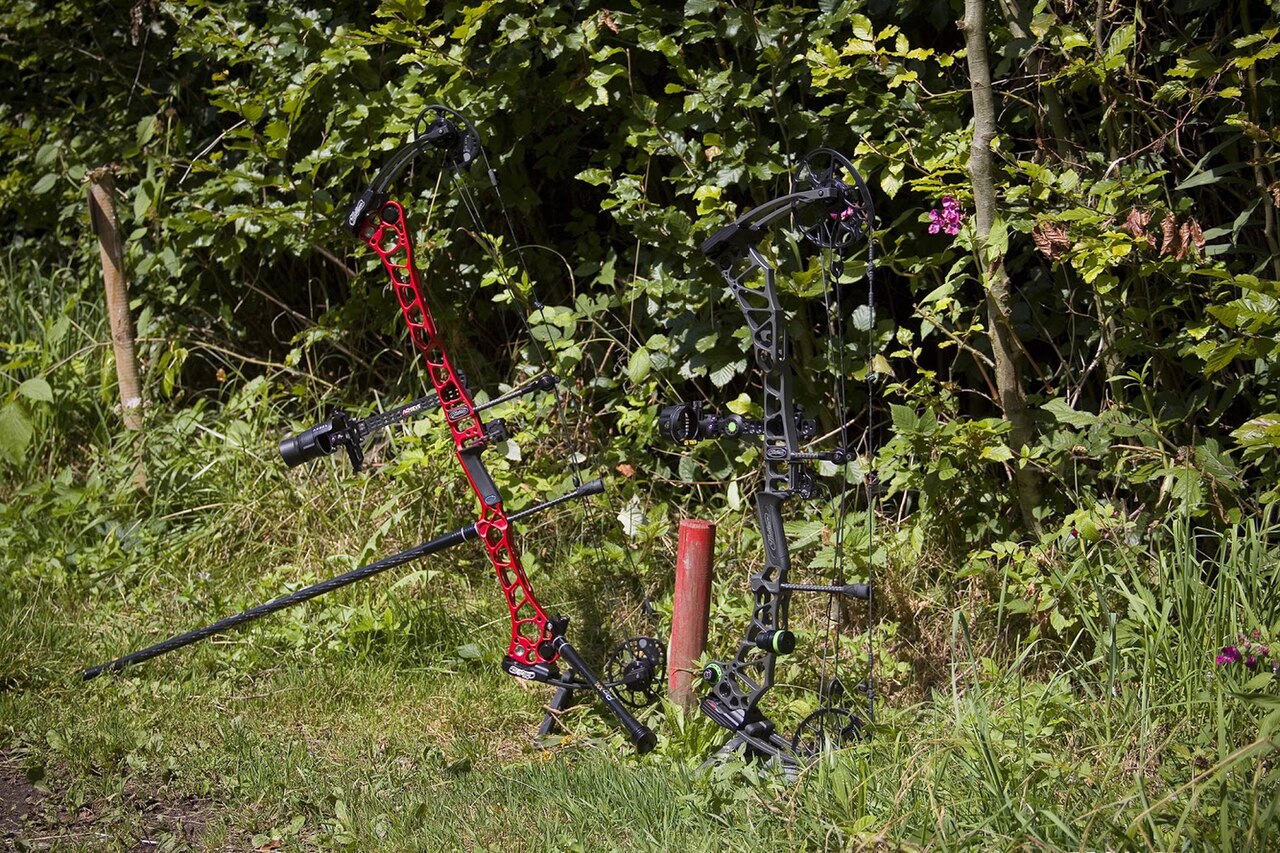
Anatomy of a Compound Bow
Before you buy or shoot, learn the parts. Knowing what each component does makes setup, tuning, and troubleshooting far easier.
- Riser: The central frame, usually machined aluminum or carbon. Houses the grip, sight, arrow rest, and stabilizer.
- Limbs: The flexible arms that store energy when drawn. Most modern compounds use split limbs for stability.
- Cams: The wheels at the end of each limb. Single cam, hybrid cam, and dual binary cam systems all have trade-offs in tuning and speed.
- Bowstring & Cables: The string you draw and the cables that connect to the cams. Replace every 2–3 years or 5,000 shots.
- Cable Slide / Cable Guard: Keeps the cables out of the arrow’s path.
- D-Loop: A small loop tied to the bowstring where you attach your release aid.
- Peep Sight: A small ring set into the bowstring that you look through to align with your front sight.
- Arrow Rest: Holds the arrow during the draw and shot — drop-away rests are now the standard.

How to Choose the Right Compound Bow
Buying a compound bow is not like buying a fishing rod. Fit matters more than brand. A bow that’s wrong for your body will make you a worse archer, no matter how much you spend.
1. Draw Length
Draw length is the distance from the bowstring at full draw to the throat of the grip, plus 1.75 inches. Most adult archers fall between 26″ and 31″. The fastest way to estimate yours: stand with arms outstretched in a T-pose, measure your wingspan in inches from middle fingertip to middle fingertip, and divide by 2.5. A 70-inch wingspan suggests a 28-inch draw length.
Get this wrong and you’ll fight the bow forever. Get it right and shooting feels natural.
2. Draw Weight
Draw weight is the peak force needed to pull the bow back, measured in pounds. Modern compounds are usually adjustable across a 10-pound range (e.g., 60–70 lbs).
- Beginners: Start at 40–50 lbs. You should be able to draw the bow smoothly while seated, without straining.
- Target archers: 50–60 lbs is plenty for indoor and field shooting.
- Bowhunters: 55–70 lbs depending on game — 50 lbs is the legal minimum in most states for deer.
Heavier is not better. An over-bowed archer flinches, punches the trigger, and develops bad habits that take years to fix.
3. Axle-to-Axle Length and Brace Height
Shorter axle-to-axle bows (28–32″) are maneuverable and great for treestand hunting. Longer ones (33–38″) are more forgiving and preferred for target work. Brace height — the distance from the grip to the string at rest — affects forgiveness too: 6–7″ is fast but unforgiving, 7–8″ is the modern sweet spot.
Best Compound Bows to Consider in 2026
Rather than chase the latest flagship, look for a bow that fits, holds tune, and has good dealer support. Below are three categories worth your attention — entry-level, mid-tier all-rounder, and high-performance — with reliable picks in each.

The Diamond Edge 320 from Bowtech is the gold-standard beginner package. It adjusts from 7″ to 31″ draw length and 7 to 70 lbs draw weight without a press, meaning it grows with your kids or scales up as your strength improves. The full ready-to-shoot package includes sight, rest, quiver, stabilizer, and peep — everything you need to walk to the range the same day.
Mid-Tier All-Rounder
If you’ve been shooting for a year and want to upgrade, look at bows in the $700–$1,000 range. The Bear Archery Adapt 2, PSE Brute ATK, and Mathews Phase4 all deliver flagship-level smoothness and accuracy at significantly lower prices.

High-Performance / Hunting Flagship
If you’ve outgrown your starter bow and want a hunting flagship, the Hoyt RX-9 and Mathews Lift 33 set the bar in 2026 — carbon risers, 340+ FPS speeds, and the smoothest draw cycles in the industry. Expect to spend $1,200–$1,800 for a bare bow.

Essential Compound Bow Accessories
A bare compound bow is unfinished. Here’s the minimum kit:
- Sight: Single-pin (HHA, Spot Hogg) for hunters who range targets, or multi-pin (Black Gold, IQ) for known-distance shooting.
- Arrow Rest: Drop-away (QAD, Hamskea) is the modern default — it falls out of the way at the shot for clean fletching clearance.
- Stabilizer: 8–12″ front bar for hunting, longer plus a back bar for target.
- Release Aid: Index-finger release for hunters, hinge or thumb-trigger for target archers.
- Quiver: Detachable bow-mounted or hip quiver.
- Arrows: Carbon shafts (Easton, Gold Tip, Victory) spined to your draw weight and length. Always consult a spine chart.
Setting Up and Tuning Your Compound Bow
Out of the box, a compound bow is rarely shooting its best. A proper setup makes the difference between hitting paper plates and stacking arrows.
The Setup Checklist
- Set draw length at the cam (usually a rotating module).
- Set draw weight with the limb bolts — turn equal amounts on top and bottom.
- Tie in a D-loop on the string above and below the nock point.
- Install peep sight at eye height when you reach full draw.
- Center the arrow rest so the arrow points straight through the Berger button.
- Paper tune — shoot through paper at 6 feet. The arrow should leave a clean bullet hole. Tail-left, tail-right, nock-high, and nock-low tears all have specific fixes.
- Walk-back tune at 20, 30, 40, and 50 yards to confirm centershot.
If any of this feels intimidating, your local pro shop will set up and tune the bow for $50–$100 — money very well spent.
Shooting Form Fundamentals
The best compound bow on Earth won’t fix bad form. Drill these basics until they’re automatic:
- Stance: Feet shoulder-width, slightly open to the target.
- Grip: Relaxed. The bow should rest on the meaty pad of your thumb, fingers loose. A death grip causes left-right misses.
- Anchor: Same spot every shot — knuckle to ear, string to nose, peep aligned with sight housing.
- Back tension: Pull through the shot using your back muscles, not your trigger finger.
- Follow-through: Stay in the shot. Don’t drop your bow arm before the arrow hits.
Watch: Compound Bow Basics in Action
Visual learners — this beginner walkthrough covers the same fundamentals on the range:
Maintenance and Care
Compound bows are mechanical. They need care:
- Wax the string every 2–3 weeks or whenever it looks dry.
- Inspect cables and cams for fraying, cracks, or serving separation before every session.
- Replace strings and cables every 2–3 years, or sooner with heavy use.
- Never dry-fire — releasing the string without an arrow can shatter limbs and cams.
- Store in a case away from extreme heat (a hot car will warp limbs).
Final Thoughts
A compound bow rewards the archer who matches gear to body, takes setup seriously, and puts in disciplined practice. Don’t fall for the hype around the newest flagship — a properly fitted entry or mid-tier bow shoots better in trained hands than a $1,800 carbon flagship in untrained ones. Start with the right draw length, a manageable draw weight, a quality drop-away rest, and a sight you trust. Get tuned by a pro shop. Then shoot every day you can. Within a season, you’ll be hitting targets at 40 yards that you didn’t think were possible on day one.
Welcome to the compound bow world — it’s a deep, rewarding rabbit hole, and the gear in 2026 has never been better.
Sources
- Archery Trade Association — Industry standards and education
- USA Archery — Official rules and beginner programs
- Lancaster Archery Learning Center — Tuning and setup guides
- Hoyt Archery — Cam systems and bow technology
- Bear Archery Blog — Beginner resources
- Bowhunting.com — Field-tested how-to articles
