Archery Blog
Rotator Cuff Injuries in Archery: Prevention, Symptoms, and Recovery
Jul
The Rotator Cuff and Why Archery Stresses It
The rotator cuff is a group of four muscles — supraspinatus, infraspinatus, teres minor, and subscapularis — and their tendons that wrap around the head of the humerus and attach it to the shoulder blade. Their job is to stabilize the glenohumeral joint (the ball-and-socket of the shoulder) while the larger prime movers like the deltoid and trapezius generate gross movement and power. Without a healthy rotator cuff, the shoulder joint becomes unstable and the larger muscles cannot function safely.
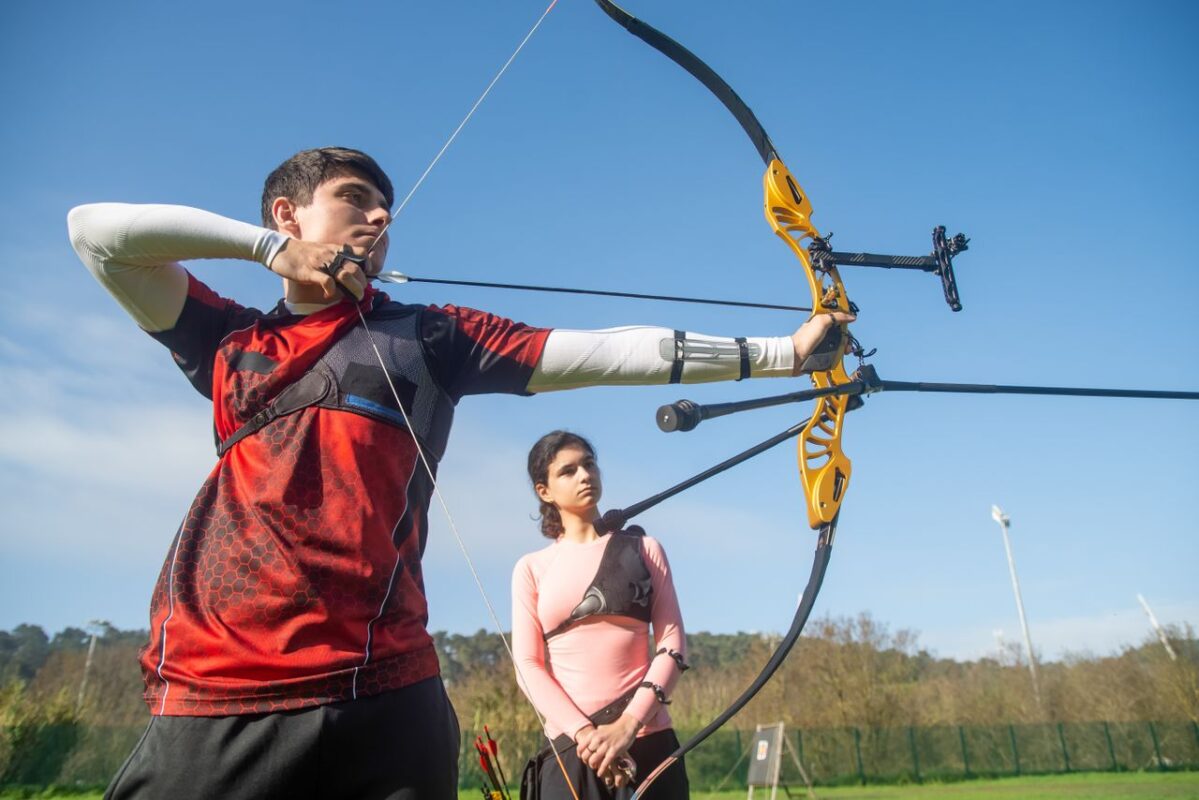
Archery is particularly demanding on the rotator cuff because drawing a bow requires both high force and precise positional control simultaneously. On the draw arm, the muscles work concentrically to pull the string back. On the bow arm, they work isometrically to hold the shoulder stable against the bow’s forward pressure. Both mechanisms place the rotator cuff under sustained, repetitive load — exactly the condition that produces overuse injury when training volume or intensity exceeds the cuff’s capacity to recover.
The draw shoulder is typically the most vulnerable. Pulling a 40- to 70-pound bow to full draw and holding it there while aiming engages the infraspinatus and teres minor heavily in external rotation. When these muscles fatigue, the supraspinatus takes compensatory load and becomes vulnerable to impingement between the humeral head and the acromion — a bony ledge at the top of the shoulder. Supraspinatus tendinopathy and partial tears are among the most common rotator cuff injuries in archery populations.
Strain vs. Tear: Understanding the Spectrum
Rotator cuff injuries exist on a continuum. At the mild end, a strain involves micro-tearing of muscle or tendon fibers without structural compromise. The tissue is intact but inflamed and painful. With appropriate rest and progressive rehabilitation, strains typically resolve in two to six weeks.
Partial-thickness tears involve actual disruption of some but not all tendon fibers. They hurt more, take longer to heal, and may require a longer rehabilitation period — often three to six months of structured physical therapy. Full-thickness tears go all the way through the tendon. Depending on size and the individual’s functional requirements, these may be managed conservatively (with physical therapy) or surgically. Archery is a high-demand repetitive overhead-adjacent activity, and large full-thickness tears in active archers often benefit from surgical evaluation.
Red Flags: Symptoms That Should Not Be Ignored
Rotator cuff injuries produce recognizable symptoms, but their early presentation can be subtle enough to dismiss. Do not do so. Early intervention dramatically improves outcomes.
Sharp pain at the top of the draw. Catching pain at the very end of the draw cycle, when the shoulder is fully loaded and at end range, suggests impingement or tendon stress in the supraspinatus. Dull aching during and after shooting is one thing; sharp pain that makes you flinch is another. Sharp pain during activity means the load is exceeding what the tissue can manage.
Night pain. One of the most reliable markers of significant rotator cuff pathology is pain that wakes you from sleep, particularly when lying on the affected shoulder. Night pain indicates tissue irritation at rest — a sign that something more than simple fatigue is happening. If you cannot sleep on your draw-arm shoulder, see a sports medicine doctor.
Weakness in specific planes. Difficulty lifting the arm to the side (abduction), reaching behind the back, or maintaining arm position at 90 degrees against resistance all suggest specific rotator cuff muscle involvement. An orthopedic assessment can pinpoint which structure is affected.
Clicking or grinding. Some shoulder noise is normal. Persistent, painful clicking or grinding with movement may indicate tendon pathology or other intra-articular problems that warrant imaging (ultrasound or MRI).
Rehabilitation Exercises for Rotator Cuff Health
Rehabilitation for rotator cuff strains and minor partial tears follows a progressive loading approach. Begin with pain-free range-of-motion exercises before introducing resistance work.
External rotation with a resistance band. Stand with your elbow at 90 degrees, upper arm held against your side, and a light resistance band anchored to your left (for the right arm). Rotate the forearm outward, pulling the band away from your body, then return slowly over three seconds. This works the infraspinatus and teres minor directly — the draw-shoulder muscles most stressed in archery. Three sets of 15 repetitions, avoiding any painful range, is a standard starting point.
Side-lying external rotation. Lie on your non-injured side with the affected arm on top, elbow bent to 90 degrees and upper arm resting on your torso. Rotate the forearm upward (thumb toward ceiling) against gravity or a very light weight, then lower slowly. This isolates the external rotators without engaging the deltoid.
Scapular stabilization work. A significant proportion of rotator cuff problems are compounded by poor scapular control — the shoulder blade doesn’t move correctly, which narrows the subacromial space and increases impingement risk. Exercises like prone Y-T-W and wall slides train the lower trapezius and serratus anterior to position the scapula optimally during arm elevation.
Poundage Management as Injury Prevention
The most preventable rotator cuff injuries in archery are those caused by too much poundage, too soon. The rotator cuff’s capacity to stabilize the shoulder against a heavy bow develops gradually — measured in months, not weeks. An archer who can muscle through a heavy draw early in their progression is not the same as an archer whose rotator cuff has adapted to that load. The difference between them is injury risk.
A practical poundage management approach: your current draw weight should feel controlled and stable at full draw for every arrow in your session, including the last one. If the last ten arrows of a 100-arrow session feel harder to hold steady than the first ten — if your bow arm shakes or your draw shoulder aches — you are shooting more poundage than your shoulder can currently handle. Drop 5 pounds and rebuild.
Browse our bow selection for options across a range of draw weights — finding a bow that matches your current strength level is one of the most important injury-prevention decisions you can make as an archer. Our compound bow guide covers how to match draw weight to your shooting stage.
Returning to Shooting After a Rotator Cuff Injury
Return-to-shooting following rotator cuff rehabilitation should be graduated. Start with low poundage — ideally 50 to 60 percent of your normal draw weight — and short sessions of 20 to 30 arrows. Monitor pain and fatigue over the 24 hours following each session. If no symptoms emerge, increase arrow count before increasing poundage. Add poundage last, and only in small increments.
Do not rush the return. A fully rehabilitated rotator cuff will serve you for decades of archery. A premature return that causes re-injury resets the clock and, in the case of tendon injuries, often leaves the tissue weaker than before. Work with a sports physiotherapist who understands overhead and throwing athletes — many rotator cuff rehab principles translate well to archery.
