
Archery Blog
Archery Finger Tab vs Glove: 5 Key Differences and Which to Choose

Aug
Every recurve archer hits this crossroads within the first few months. Your fingers sting from string contact, the range veteran next to you is shooting a personal best with a worn leather tab, and you’re standing there with a shooting glove wondering if you’ve been doing it wrong. The honest answer depends entirely on what you’re shooting for.
This guide breaks down the real differences between archery finger tabs and shooting gloves, examines what the competitive record actually tells us about accuracy, and explains exactly when each option makes sense — including the scenarios where switching between the two is a legitimate strategy.
What Is a Finger Tab in Archery?
A finger tab is a flat shield — typically made from leather, synthetic material, or a layered combination of both — worn on the index, middle, and ring fingers of the drawing hand. It sits between the fingertips and the bowstring, reducing friction on the skin and creating a consistent, smooth surface for the string to roll off during release.
Modern tabs come in several configurations. The basic recurve tab is a single piece of smooth leather covering all three drawing fingers. Olympic-style tabs go considerably further: they add a metal or plastic frame, a finger spacer between the index and middle fingers, and sometimes an integrated pressure button or shelf to help establish a repeatable anchor. The finger spacer is the detail that matters most for precision — it prevents “nocking pinch,” where the fingers inadvertently squeeze the arrow nock during the draw and deflect the arrow before it clears the rest.
Tabs are the equipment standard for World Archery competitions at all levels, from club tournaments to the Olympics. At elite recurve events, every shooter on the line uses a tab.
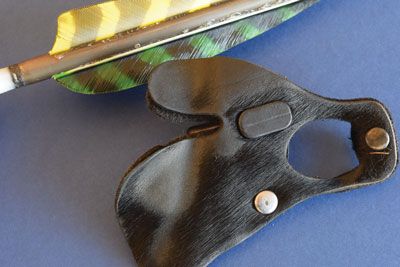
A two-piece leather finger tab showing the typical construction used by recurve and barebow shooters.
What Is an Archery Shooting Glove?
An archery shooting glove covers the three drawing fingers — index, middle, and ring — with individual slots of leather or synthetic material, leaving the palm and remaining fingers exposed. A strap or velcro wrap secures it around the hand. Unlike the integrated design of a tab, the glove treats each finger as a separate protected contact point.
The glove’s most significant advantage is that it stays put. For traditional bowhunters moving through thick brush, drawing from a ground blind, or making a quick shot when an animal steps into a clearing, a tab can shift or require conscious repositioning. The glove is always ready. You put it on and forget it until the moment you draw.
That convenience comes with trade-offs in release quality. Most shooting gloves have stitched seams around each finger slot, introducing slightly more material variability at the release point compared to the flat, smooth surface of a tab. In controlled target conditions this shows up in group consistency. In the field at 20–30 yards, the difference is rarely the limiting factor in a missed shot.
NUSensei breaks down the practical differences between tabs and gloves for recurve archers.
Archery Finger Tab vs Glove: 5 Key Differences
Most discussions of this topic treat it as a personal preference call. That framing misses how different these two tools actually function. Here are the five differences that matter in practice.
Release surface consistency. A tab’s flat, smooth surface creates the same string contact point every draw cycle. Shooting gloves have stitched individual slots, and the precise position of each slot against the string can vary slightly between shots. Over a 72-arrow target round, that variability accumulates.
String-to-skin cushioning. High-end Olympic tabs stack multiple layers — a structural base, a smooth leather or cordovan face, sometimes a foam insert under the string contact zone. This layering places the string slightly further from the finger and reduces micro-deflection during release. Gloves are purposely thin to maintain dexterity and put fingers in closer string contact.
Field security. A glove stays on the hand without adjustment. A tab requires correct placement on the fingers before each round — typically a three-second process that becomes automatic, but one that creates a failure point during cold-weather shooting or when drawing quickly in the field.
Temperature performance. Cold weather changes the equipment equation. A finger tab worn over numb fingers or thin liner gloves shifts and becomes unreliable. Many traditional hunters run tabs from April through October, then switch to gloves for November season when temperatures drop in their hunting territory.
Price range and entry point. Basic shooting gloves start around $10–15 and are widely available. Quality recurve finger tabs from brands like Cavalier, Shibuya, NAP, or AAE range from $20 to $120 for competition models. The performance gap between entry-level and competition tabs is real — a $30 tab from a reputable archery-specific brand outperforms a $10 generic option in ways you will feel in your groups within a session.
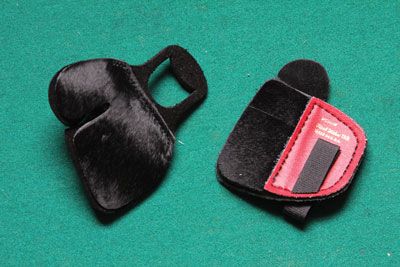
A split-finger tab (left) and a three-under tab (right) — two common configurations for different shooting styles.
Which Gives Better Accuracy: Tab or Glove?
The tab wins on accuracy, and the record behind that conclusion is not subtle. Every World Archery world record in recurve — across all Olympic distances and all gender categories — has been set by an archer using a finger tab. That pattern has held consistent since recurve archers standardized on tabs during the 1970s.
The mechanical reason is the release. When a recurve string releases, it rolls off the fingertips. A flat, uniform tab face allows this roll-off without interruption. A glove with stitched seams can create minor binding or variation as the string clears each finger — imperceptible at short distances, measurable at 70 meters over a full competition round.
Olympic archer Deepika Kumari, one of the most decorated recurve shooters in history, has competed with a finger tab throughout her career, including three World Archery Championship gold medals. Brady Ellison, dominant in men’s recurve for over a decade, uses a tab. If there were accuracy gains available from a glove at the competitive level, elite archers would have found them. They have not.
At typical recreational distances — 18 meters indoor, or 20–30 yards in the backyard — the accuracy difference between a quality glove and a quality tab is present but not dramatic. A beginner with good form using a well-fitted shooting glove will outshoot an advanced archer using a poorly maintained or incorrect-sized tab every time.
When to Choose a Glove Over a Tab
The shooting glove is not the inferior option — it is the correct option in specific, well-defined conditions.
Traditional bowhunters who shoot instinctively at distances under 30 yards have legitimate reasons to run a glove year-round. When a deer steps into your shooting lane, you do not want to check whether your tab has shifted. The glove is already there.
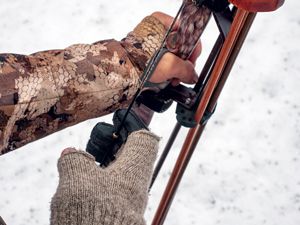
A traditional bowhunter using a three-finger shooting glove — the right call when a quick draw from awkward positions is part of your daily shooting scenario.
Longbow shooters running traditional field courses also often prefer gloves. Walking 28 targets through varied terrain — kneeling at some, crouching at others, taking shots from hillsides — a glove’s zero-fumble reliability beats the minor accuracy advantage of a tab when distances never reach 70 meters.
Youth archers at the beginning stages sometimes handle gloves more naturally, because there is one fewer equipment variable to manage. Most coaches transition students to tabs once form mechanics are established, usually within the first six to twelve months of regular practice.
How to Fit a Finger Tab Correctly
A poorly fitted tab actively hurts accuracy more than no protection at all. The index finger slot should sit at the base of the first knuckle crease, not further toward the fingertip. Positioning the tab too high causes it to bunch and fold during the release — a consistent accuracy problem that beginners often blame on form before diagnosing the tab fit.
The middle finger carries the majority of string load on a recurve draw. The tab must lie flat across the middle finger at full draw without buckling. If it buckles, the tab is too large. Most quality tabs come in small, medium, and large based on measurements from palm base to middle finger tip — take that measurement before purchasing rather than guessing at sizing.
New leather tabs require break-in time. A fresh tab feels stiff and can produce inconsistent releases for the first 100–300 shots. The leather gradually molds to your finger widths and softens at the contact zone. Resist judging a new tab on its first session — the break-in period is real and it pays off on the other side.
Can You Switch Between Tab and Glove?
Most archers who do both — indoor target with a tab, outdoor bowhunting with a glove — report a 10–20 shot adjustment window each time they switch. The draw feel is different enough at the finger contact point that the first few arrows after switching tend to land slightly off until muscle memory recalibrates.
What you should avoid is using both interchangeably within the same practice session or competition round. The physical rhythm of the shot sequence depends on consistency at every phase, including the precise feel of string contact. Mixing equipment types inside a session disrupts that consistency in ways that are hard to diagnose.
Some traditional archers simply commit to a glove year-round and accept the minor accuracy trade-off as irrelevant for instinctive shooting inside 25 yards. If your goals do not include formal target competition, this is a rational equipment choice. Getting your bowhunting shot placement dialed in matters far more than your finger protection choice at hunting distances.
The Bottom Line
Target archery and Olympic recurve: use a finger tab. Invest in a mid-range tab from a dedicated archery brand, allow time for proper break-in, and you will see the difference in your groups within a month. The competitive record on this point spans five decades and is not ambiguous.
Traditional bowhunting and field shooting inside 30 yards: a well-fitted shooting glove is a legitimate and practical choice. The small accuracy trade-off is not meaningful at hunting distances, and the always-ready reliability advantage is real when animals don’t give you time to reposition equipment.
New to recurve and not sure which direction you’ll go? Start with a quality tab. If you later move toward traditional bowhunting, picking up a shooting glove is a $15–25 experiment. Going the other direction — transitioning from a glove to a tab — takes more time but is how most recurve archers end up once competition pulls them in.
Sources
- World Archery Technical Regulations — Official equipment specifications for recurve competition including finger protection standards
- Traditional Bowhunter Magazine: Glove or Tab? — In-depth field comparison from experienced traditional bowhunters including Wayne van Zwoll and Jason Wesbrock
- USA Archery — National governing body resources for equipment selection and beginner archer development
- Archery 360 — Equipment guides and technique resources for all archery disciplines
