Archery Blog
Arrow Spine, Material, and Fletching: A Complete Selection Framework
May
Arrow selection determines accuracy more than almost any single piece of gear in your kit. The right shaft will fly true off a $200 bow; the wrong one turns a $1,500 setup into an expensive frustration. Three variables decide whether your arrow stabilizes within ten yards or wobbles all the way to the target: spine, material, and fletching. Get those three correct and tuning becomes routine instead of mysterious.
This guide walks through how each variable interacts with your bow, your draw weight, and your shooting style — so you can spec arrows confidently whether you are setting up a target rig, a hunting rig, or a budget starter kit.
Why Spine, Material, and Fletching Are the Critical Trio
Length, point weight, insert weight, and nock fit all matter, but they are downstream variables. Spine sets how the shaft reacts to the energy of the bow at release. Material sets how durable, fast, and forgiving the shaft will be over hundreds of shots. Fletching sets how quickly an imperfect release gets cleaned up in flight. Skip any one and the others compensate badly.
An over-spined arrow with the wrong vanes can group reasonably at twenty yards and disastrously at fifty. An under-spined carbon hunter can fishtail through paper no matter how carefully you tune the rest. The interaction between the three is what matters, not any one variable alone.
Understanding Arrow Spine
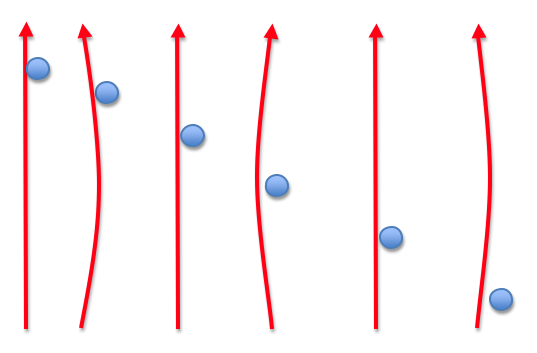
Spine is the measure of how much an arrow flexes when force is applied. It is published two ways: as static spine (a deflection number measured in thousandths of an inch under a 1.94 lb load over 28 inches) and as dynamic spine (how the arrow actually behaves when released from your specific bow).
Static Spine: The Number on the Box
Manufacturers stamp spine ratings like 340, 400, 500, or 600 on the shaft. Lower numbers mean a stiffer arrow. A 340 deflects less than a 500. Static spine is what charts use, but it is not the whole picture — it is the starting point for matching, not the answer.
Dynamic Spine: What Actually Flies
Dynamic spine accounts for arrow length, point weight, insert weight, draw weight, draw length, cam aggression, and even string material. Two archers shooting the same 400-spine shaft can get wildly different flight if one is pulling 70 lbs at 30 inches with a 100-grain field point and the other is pulling 55 lbs at 27 inches with a 125-grain broadhead.
The general rules: longer shafts and heavier points weaken dynamic spine. Shorter shafts and lighter points stiffen it. If you cannot tune to bare-shaft flight, dynamic spine is almost always the culprit, not your form.
Reading a Spine Chart
Every arrow manufacturer — Easton, Gold Tip, Victory, Black Eagle — publishes a chart that cross-references draw weight, draw length, and point weight against recommended spine. Use the chart that matches the brand you are buying. Do not assume Easton’s chart applies to a Victory shaft. Cam efficiency and modern compound speeds have made charts more critical, not less.
Arrow Materials Compared
Material is where price, performance, and durability collide. Each option has a clear best-use case and a clear failure mode.
Carbon Fiber
Carbon dominates modern archery for good reason. It is light for its strength, recovers quickly from paradox, and is consistent shaft to shaft when manufactured well. Quality carbon (sub-.003 inch straightness tolerance) is the default for hunting, 3D, and most target work.
Carbon’s weakness is impact damage. A nicked or cracked carbon shaft can shatter on release and send splinters into your hand. Always flex-test carbon arrows before shooting and retire any shaft that creaks or shows visible damage. This is not optional — it is a safety rule.
Aluminum
Aluminum arrows like the Easton XX75 line were the dominant choice for decades. They are heavier than carbon (slower trajectory), cheaper, and physically forgiving — they bend instead of shattering. A bent aluminum shaft can sometimes be straightened on a jig; a damaged carbon shaft is trash.
Aluminum is excellent for indoor target archery where shaft diameter matters for line-cutting, for budget setups, and for archers who want a forgiving shaft that holds up to being pulled out of foam targets repeatedly. The trade-off is weight and the resulting drop in trajectory.
Aluminum-Carbon Hybrids
Easton’s A/C/E and X10 shafts wrap a thin aluminum core in carbon. The result is the small-diameter, high-front-of-center performance that Olympic recurve and target compound shooters demand. They are expensive but consistent at the highest level. If you are shooting a Vegas indoor round or a 70-meter outdoor round seriously, hybrids are the answer.
Wood
Wood arrows are reserved for traditional bows, longbows, and archers who care about period correctness. Cedar and Port Orford pine are the classics. Spine consistency is harder to control and shafts must be matched and straightened by hand. Beautiful, but never the right answer for a compound or modern Olympic-style recurve.
Fletching: The Last Three Inches Matter Most
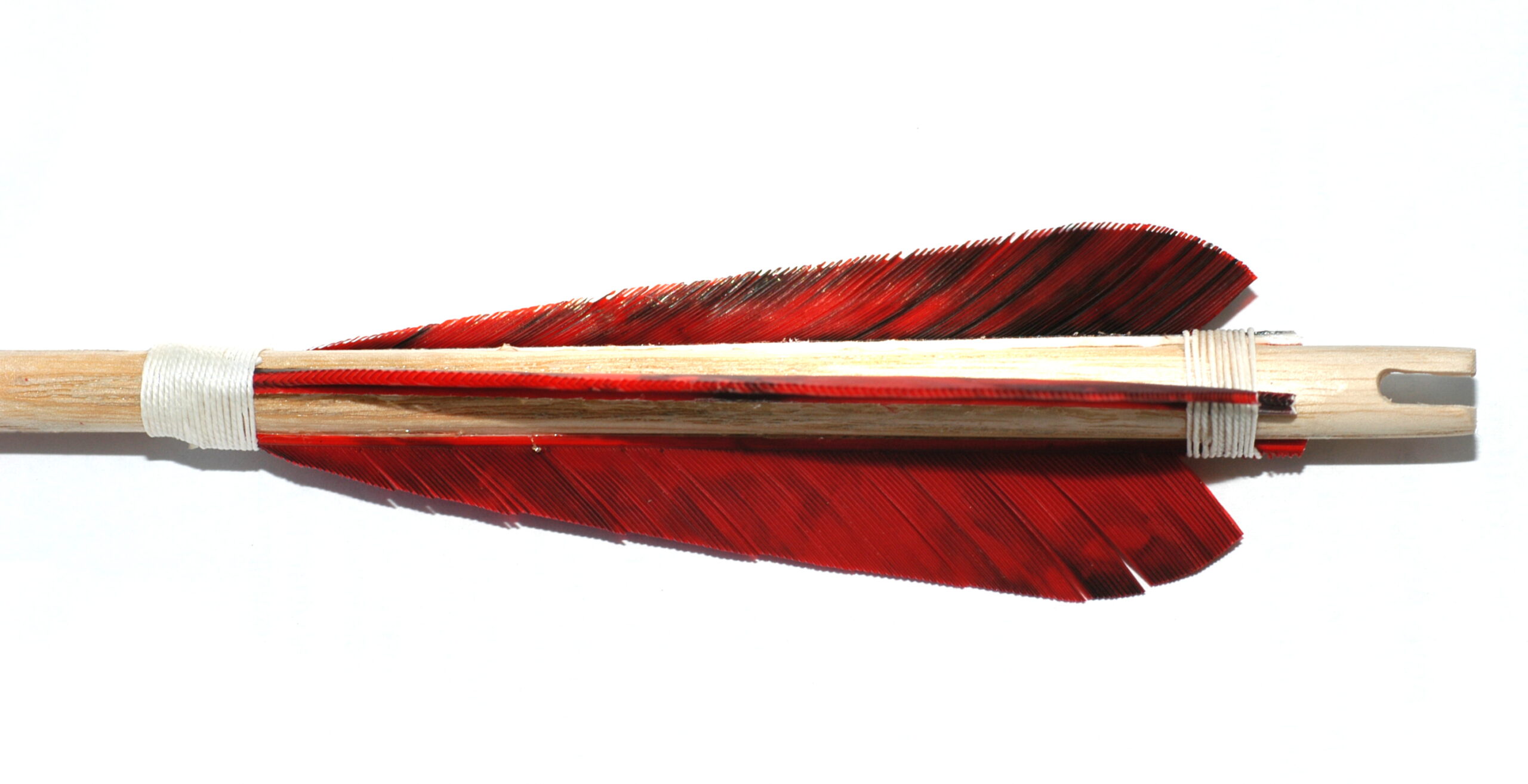
Fletching steers the arrow. The further from the bow you measure, the larger the effect of fletching choice. There are three independent decisions to make: material, profile, and orientation.
Vanes vs Feathers
Plastic vanes are weatherproof, durable, and consistent. They are the right answer for compound shooters and for any rig that uses an arrow rest with a launcher (drop-aways, blade rests, Whisker Biscuits). Vanes recover quickly from off-center launches and survive being pulled through dense target foam without going limp.
Feathers are lighter, more forgiving of imperfect rest contact (they crush instead of deflecting), and the traditional choice for recurve, longbow, and finger shooters. They lose performance in heavy rain. If you are shooting off the shelf or with a flipper rest, feathers are usually the better answer.
Profile: Low, Mid, or High
Profile is the height of the vane from the shaft. Low-profile vanes (Bohning Blazers at 2 inches, Vanetec swift profiles) are fast, forgiving, and dominate hunting and 3D. Higher-profile vanes (4 to 5 inch parabolics) offer more steering for fixed-blade broadheads and longer shots, at the cost of speed and noise.
Hunters using mechanical broadheads can almost always get away with 2-inch vanes. Hunters using fixed-blade heads should consider 3- or 4-inch vanes to overcome the steering load of an aggressive broadhead profile cutting against the air.
Helical, Offset, or Straight
How the vane attaches to the shaft determines spin. A straight fletch (vane parallel to shaft) gives maximum speed and minimum spin. An offset (vane angled slightly) introduces moderate spin. A helical (vane curved around the shaft) maximizes spin and stability.
For broadhead hunting, helical fletching is the gold standard — it spins the arrow fast enough to overcome blade-induced steering. For target shooting at known distances with field points, offset or straight will fly faster and group as well at standard ranges.
Putting It Together: A Decision Framework
Use this sequence when speccing a new set of arrows from scratch:
- Confirm draw weight and draw length at full draw. Have a shop measure if you are unsure — a half-inch error here ruins the whole spec downstream.
- Decide point weight based on intended use: 100 grains for most target work, 125 grains for hunting versatility, 150 grains and up for high-FOC hunting setups.
- Pull the manufacturer’s spine chart for the brand you want and find the cell that matches your draw weight and arrow length plus 1 inch (a common safety margin past the rest).
- Pick material based on use case: carbon for hunting and 3D, aluminum or hybrid for target, traditional materials for traditional bows only.
- Pick fletching last: 2-inch vanes with a slight helical for general hunting, 4-inch parabolics for fixed-blade heads or long-range, feathers for any traditional setup.
- Bare-shaft and paper-tune a single arrow before buying a dozen. Many shops will let you test-shoot before committing.
Common Mistakes to Avoid
Three mistakes account for most arrow disappointment in pro shops and online forums.
Buying spine by draw weight alone. Two archers at 60 lbs draw weight can need different spine arrows because of arrow length and point weight differences. Always run the full chart with all three inputs, not just the easy one.
Ignoring straightness tolerance. A .006 inch straightness shaft is acceptable for backyard plinking. For hunting at any range over 30 yards, look for .003 inch or better. Olympic-level archers want .001 inch. You can feel and see the difference at distance, even if you cannot at 20 yards.
Overspending on shafts and underspending on points. An expensive shaft fitted with a cheap, unsharp broadhead defeats the entire investment. Budget proportionally — a great $14 shaft with a $20 broadhead beats a $25 shaft with a $7 broadhead every time.
Watch: Arrow Selection Explained Visually
Frequently Asked Questions
Can I shoot the same arrows for hunting and target practice?
Yes, if the spine matches both setups. Many hunters keep two dozen arrows: one set tipped with field points for practice, one set tipped with broadheads for hunting. Same shafts, same fletching, different points — and you must verify the broadheads fly to the same point of impact before relying on them in the field.
How long should my arrows be?
Measure your draw length, then add at least 1 inch in front of the rest to keep the broadhead or field point safely past the riser at full draw. Most hunters cut to draw length plus 1.5 to 2 inches for margin. Target archers can run shorter for spine reasons because no broadhead overhang is needed.
Do I need to weigh every arrow?
For hunting at standard distances, manufacturer weight matching (within plus or minus 2 grains) is fine. For long-range or competitive target archery, sort by total weight and FOC, and shoot only matched arrows in the same set or end.
What is FOC and does it matter?
Front-of-center is the percentage of total arrow weight that sits forward of the shaft midpoint. Higher FOC (12 to 20 percent) penetrates better and flies more stably at distance. Most modern hunting setups land between 10 and 15 percent naturally; chasing extreme FOC requires heavy inserts and careful spine matching to avoid weakening dynamic spine.
Final Thoughts
Arrow selection is not mystical. Spine sets the foundation, material decides the trade-off between speed, durability, and consistency, and fletching cleans up the last details of flight. Run the chart, match the components to the use case, and tune one shaft before you buy twelve. Do that and the arrows you pull from your quiver will become the most reliable part of your setup — not the variable you keep blaming when groups open up.
Sources
- Easton Archery — Hunting and Target Spine Charts
- Gold Tip — Arrow Spine Selection Chart
- Archery Trade Association — Industry Standards
- Bowhunter Magazine — Arrow Spine Explained
