Archery Blog
The Complete Compound Bow Guide: How to Choose, Tune, and Shoot in 2026
Apr
A modern compound bow is the most efficient, accurate, and forgiving stick-and-string a person can buy — but only if you choose, set up, and shoot the right one. With dozens of models, hundreds of accessory combinations, and marketing copy that sounds identical from brand to brand, picking your first (or next) rig can feel paralyzing. This compound bow guide walks you through everything that actually matters: how a compound works, the specs you should care about, the accessories worth your money, and the tuning steps that turn a stock bow into a tack-driver.
What Is a Compound Bow?
A compound bow uses a system of cams (eccentric pulleys) and cables to store energy more efficiently than a traditional recurve or longbow. As you draw the string back, the cams rotate and the bow reaches “peak weight” somewhere in the middle of the draw cycle. After that, the cams roll over and the holding weight drops dramatically — a feature called let-off, typically between 75% and 90%.
The result: you can hold a 70-pound bow at full draw using only 7 to 17 pounds of effort, giving you the time and stability to aim precisely. Combine that with a mechanical release aid, a multi-pin sight, and an arrow rest that drops away on the shot, and you have a system capable of repeatable accuracy at distances that would be unthinkable with a stick bow.
Anatomy of a Compound Bow
Before you shop, you need a vocabulary. Here are the parts every compound bow shares:
- Riser — the central frame, usually CNC-machined aluminum or carbon. This is where every accessory bolts on.
- Limbs — the flexible arms that store energy. Modern bows use split limbs almost exclusively.
- Cams — the eccentric wheels at each limb tip. Single cam, hybrid cam, and dual (binary) cam systems all have trade-offs in tunability and speed.
- Bowstring and cables — high-modulus polyethylene strands that transfer energy to the arrow.
- Cam stops or wall — the hard stop you feel at full draw. A solid wall is critical for repeatable anchor and shot execution.
- Grip — where your bow hand sits. A neutral, low-torque grip is the foundation of accuracy.
The Specs That Actually Matter
Draw Length
Draw length is the single most important spec on a compound bow, and the one most beginners get wrong. Unlike a recurve, a compound is built for your draw length — usually adjustable in half-inch increments via cam modules or rotating mods. Too long and you’ll over-extend your bow arm, push your face into the string, and watch arrows scatter. Too short and you’ll lose power and feel cramped.
A quick estimate: measure your wingspan in inches and divide by 2.5. A 70-inch wingspan = a 28-inch draw length. But always confirm at a pro shop with a draw board before locking it in.
Draw Weight
Draw weight is how much force you pull at peak. For hunting, most U.S. states require a minimum of 40 pounds, and 60–70 pounds is the sweet spot for whitetails, elk, and bigger game. For target archery, 50–60 pounds is plenty.
The biggest mistake new archers make is buying too much bow. If you can’t draw the bow smoothly while seated, with the bow pointed at the ground, it’s too heavy. Form breaks down long before muscle does.
Axle-to-Axle (ATA) Length
This is the distance between the two cam axles. Short ATA bows (28–31 inches) are maneuverable in tree stands and ground blinds — ideal for hunters. Long ATA bows (33–38 inches) are more forgiving and stable — preferred for target shooters and 3D competitors.
Brace Height
The distance from the grip to the resting string. A short brace height (5.5–6 inches) generates more arrow speed but is less forgiving of form errors. A taller brace (7+ inches) is slower but more accurate for the average shooter. Beginners should prioritize forgiveness over speed.
IBO Speed
Manufacturers list “IBO speed” — the speed of a 350-grain arrow shot from a 70-pound, 30-inch bow. Real-world speed will be 20–40 fps slower depending on your setup. Don’t chase IBO numbers; chase a smooth draw cycle.
Choosing Your First Compound Bow
If you’re brand new, you have three sensible paths:
- Ready-to-shoot (RTS) packages — bow + sight + rest + quiver + stabilizer for $400–$700. Great value, dialed by the manufacturer to work as a system.
- Mid-tier flagship from last year — last year’s flagship at 30–40% off this year’s model. Identical performance for $300 less.
- Used from a reputable pro shop — many shops resell trade-ins after a full safety inspection. You can get a $1,200 bow for $500 with a fresh string.

Essential Compound Bow Accessories
A bare bow is just a paperweight. Here’s the accessory stack you’ll need:
- Sight — multi-pin (3, 5, or 7 pins) for hunting, single-pin slider for target. Look for adjustable second and third axis levels.
- Arrow rest — a full-containment drop-away rest like the QAD HDX or Hamskea Hybrid Hunter is the modern standard.
- Stabilizer — 6–10 inches for hunting, 27–33 inches plus side bars for target. Reduces hand torque and quiets the bow.
- Release aid — index-finger (wrist strap) for hunting beginners, hinge or thumb-button for target precision.
- Peep sight — installed in the bowstring at eye level. 3/16″ is the most common diameter.
- D-loop — small piece of cord tied to the string where your release attaches. Saves the string from wear and gives a consistent anchor point.
- Quiver — bow-mounted for hunting, hip or back quiver for the range.
Arrows: The Other Half of Accuracy
An expensive bow with mismatched arrows will outshoot a cheap bow with the right arrows — barely. Get this part right.
Arrow spine is stiffness, expressed in numbers like 300, 340, 400, or 500 (lower = stiffer). Spine must match your draw length, draw weight, point weight, and arrow length. Use a chart from Easton, Gold Tip, or Victory to find the right spine for your setup.
For most adult hunters drawing 27–29 inches at 60–70 pounds, a 340-spine arrow with a 100-grain field point is the default. Total arrow weight should be at least 5 grains per pound of draw weight (350 grains for a 70-pound bow) for safe, efficient shooting.
Setting Up and Tuning Your Compound Bow
This is where most archers stop reading and just “send it.” Don’t. A properly tuned bow shoots tight groups; an untuned bow scatters fliers no matter how good your form is.
Step 1: Set Center Shot
Looking down the back of the bow, your arrow should align with the bowstring or slightly to the left of it (for right-handed shooters). Use the rest’s lateral adjustment.
Step 2: Set Nock Height
The arrow should sit perpendicular to the string, or with the nock slightly high — about 1/8 inch above 90 degrees is a good starting point.
Step 3: Paper Tune
Shoot an arrow through a sheet of paper at 6 feet. A perfect bullet hole means your bow is tuned. Tail-high, tail-left, or tail-right tears tell you exactly which adjustment to make. Repeat until you get a clean hole.
Step 4: Walk-Back Tune
Shoot at 20 yards using your 20-yard pin, then back up to 40, 50, and 60 yards using the same pin. If your arrows drift left or right as distance increases, micro-adjust your rest.
Step 5: Broadhead Tune (Hunters Only)
Fixed-blade broadheads expose every flaw in tuning. They should hit the same point of impact as your field points. If they don’t, your bow needs more work.
Watch: A Visual Walkthrough
If you learn better by watching, this video covers the core selection and setup concepts in real time:
Shooting Form Fundamentals
The compound bow is a tool that rewards repeatable form. Drill these basics until they’re automatic:
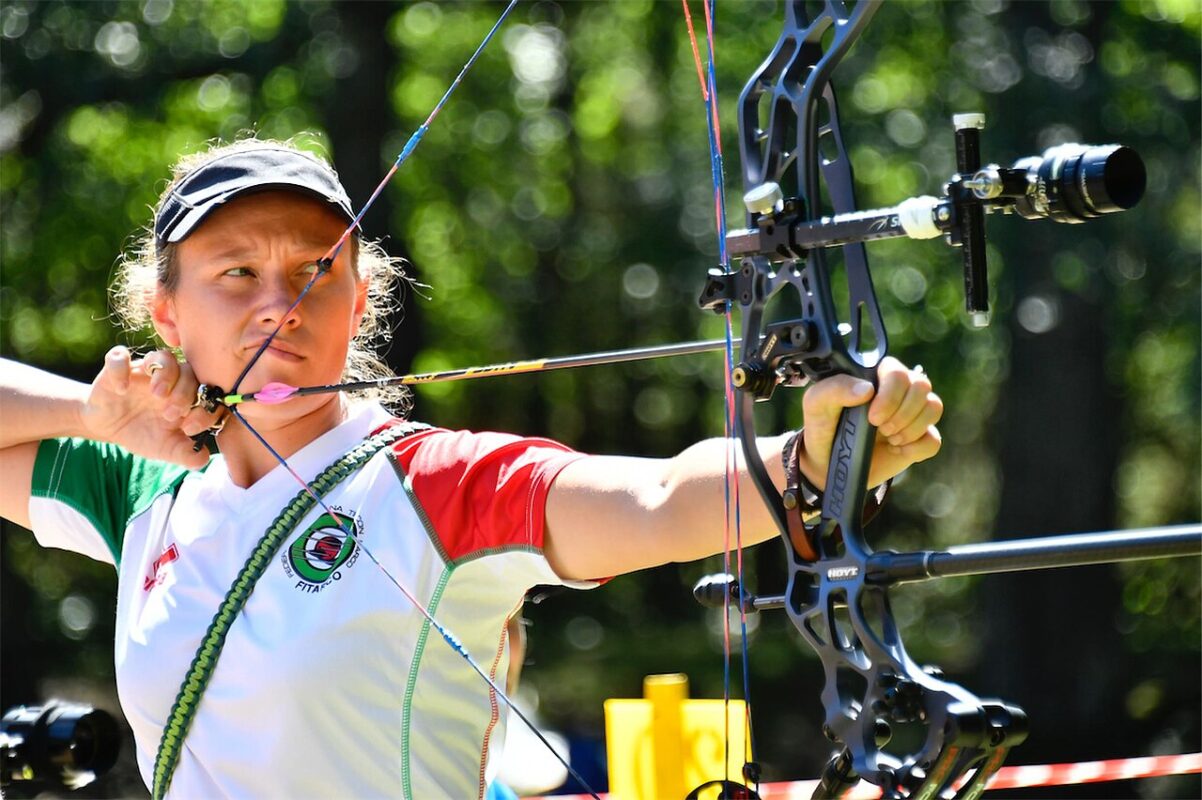
- Stance — feet shoulder-width apart, perpendicular to the target, weight evenly distributed.
- Grip — bow hand relaxed, web of the thumb against the grip’s pivot point. Knuckles at 45 degrees.
- Draw — pull with the back muscles, not the arm. Elbow stays high.
- Anchor — release knuckle against the jawbone, string touching nose or corner of mouth. Same. Every. Time.
- Aim — float the pin on the target, don’t try to hold it perfectly still.
- Release — squeeze the trigger or pull through the wall. Surprise releases shoot tighter groups than punched ones.
- Follow-through — bow arm stays up and on the target until the arrow lands.
Maintenance and Long-Term Care
A compound bow is a precision instrument. Treat it like one:
- Wax the bowstring and cables every 200 shots or every two weeks.
- Inspect the cam track and serving for fraying before every session.
- Replace strings and cables every 2–3 years, or sooner if you shoot heavily.
- Never dry fire a compound — the energy that would have gone into the arrow will destroy your limbs and cams.
- Store the bow in a hard case, away from extreme heat and humidity.
- Get a full tune-up at a pro shop annually.

Common Mistakes to Avoid
- Over-bowing. Buying 70 pounds because the box says so. Drop to 60 and shoot better.
- Wrong draw length. Get measured. Don’t guess.
- Ignoring the grip. Death-gripping the riser causes left/right misses.
- Cheap arrows. Save money on the bow, never on the arrows.
- Skipping tuning. A $1,500 untuned bow shoots worse than a $400 tuned one.
- Punching the trigger. Practice back-tension and surprise releases.
Compound Bow Buyer’s Checklist
Before you walk out of the shop, confirm:
- ✅ Draw length set to your measured number
- ✅ Draw weight you can pull smoothly while seated
- ✅ Center shot and nock height set
- ✅ Peep sight installed at your anchor
- ✅ D-loop tied and arrows spine-matched
- ✅ Sight leveled (first, second, and third axis)
- ✅ Paper-tuned bullet hole
- ✅ Bow case and stringer wax included

Final Thoughts
The compound bow rewards patience. The shooters who put in 30 minutes a day with a properly tuned mid-tier bow will outshoot the guys who bought the most expensive flagship and shoot once a month. Start with the right draw length, the right draw weight, and a bow tuned by someone who knows what they’re doing — then build the form. Speed pins, fancy stabilizers, and exotic strings come later. Fundamentals first. The arrows will follow.
Sources
- Lancaster Archery Supply — Learning Center
- Archery 360 — Equipment Guides
- Easton Archery — Arrow Selection Charts
- Bowhunter Magazine — Gear and How-To
- USA Archery — Official Governing Body
