Archery Blog
Arrow Weight and FOC: How Mass and Balance Team Up on Every Shot
Jul
Two numbers do more to decide where your arrow ends up than almost anything else on the shooting line: how much the whole arrow weighs, and how far forward its balance point sits. Most archers learn them separately — total grains in one conversation, front-of-center percentage in another — and never notice that the two are locked in a quiet tug-of-war. Change one and you almost always change the other. Understanding how arrow weight and FOC push and pull against each other is what separates an arrow that merely flies from an arrow that flies, drives deep, and forgives a slightly loose shot.
What Arrow Weight Actually Measures
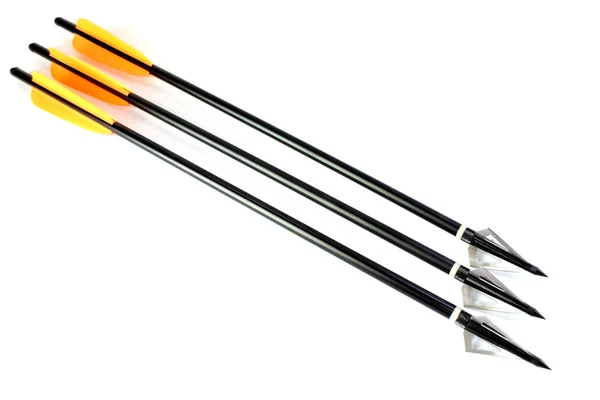
Arrow weight is measured in grains, an old ballistic unit where 7,000 grains equal one pound. A finished hunting arrow typically lands somewhere between 350 and 550 grains; a lightweight target arrow might dip to 300 or below. That total is the sum of every component: the bare shaft, the insert, the point or broadhead, the nock, the fletching, and any wraps or collars you add. Swap a 100-grain field point for a 125-grain broadhead and you have changed the arrow’s total weight — and, as we’ll see, its balance — without touching the shaft at all.
The reason grain counting matters is momentum. A heavier arrow leaves the bow slower but carries more of the bow’s stored energy downrange, resists wind better, and penetrates more reliably. A lighter arrow flies flatter and faster, which flattens your sight picture and shortens the time gravity has to work — but it sheds energy quickly and gets shoved around by crosswinds. Neither is universally “better.” The right total weight is the one matched to your bow’s draw weight and your goal for the shot.
The Grains-Per-Pound Baseline
The oldest rule of thumb ties total arrow weight to draw weight through grains per pound (GPP). Divide your finished arrow’s weight by your bow’s draw weight and you get GPP. A 420-grain arrow out of a 60-pound bow is 7 GPP. Most manufacturers set 5 GPP as the absolute minimum to avoid a near-dry-fire situation that can damage the bow, treat roughly 6–8 GPP as a balanced all-around window, and reserve 8+ GPP for maximum penetration and quiet, low-vibration shooting. GPP tells you whether your total mass is sane for your setup. It says nothing, however, about where that mass sits — and that is where FOC enters.

FOC — Front of Center in Plain Terms
Front of Center describes how far the arrow’s balance point sits ahead of its exact physical middle, expressed as a percentage of total length. An arrow that balances dead center has 0% FOC. Push the balance point forward — usually by adding weight up front — and the FOC number climbs. A well-behaved hunting arrow commonly runs 10–15% FOC; some archers chasing extreme penetration push toward 18–20% or beyond, while flat-shooting target arrows often sit lower, around 7–12%.
Why does the balance point matter at all? A forward-weighted arrow behaves like a dart or a badminton shuttlecock: the heavy nose leads, the light tail trails, and the whole thing self-corrects in flight. That nose-forward bias makes the arrow more stable, steadier through the wind, and more forgiving of the small imperfections a broadhead’s steering surfaces would otherwise amplify. Go too far, though, and the tail-heavy-versus-nose-heavy balance tips the other way — the arrow starts to drop steeply at distance and the rear can wag, hurting long-range accuracy.
How to Calculate FOC
The math is simple and worth doing yourself. First, measure the arrow’s full length from the throat of the nock to the end of the shaft (not the point tip). Call that L. Balance the finished arrow — point, insert, fletching, everything — on a straight edge and mark where it sits, then measure from the throat of the nock to that balance point. Call that A. The formula is:
FOC % = 100 × (A − L ÷ 2) ÷ L
Say your arrow is 29 inches long and balances at 16.3 inches from the nock throat. Half of 29 is 14.5. Subtract: 16.3 − 14.5 = 1.8. Divide by 29: 0.062. Multiply by 100: 6.2% FOC. Add a heavier point or a brass insert and re-measure — the balance point creeps forward and the percentage rises. A digital grain scale and a simple balance beam are the only tools you need, and they turn FOC from a mystery into something you can dial by tenths.
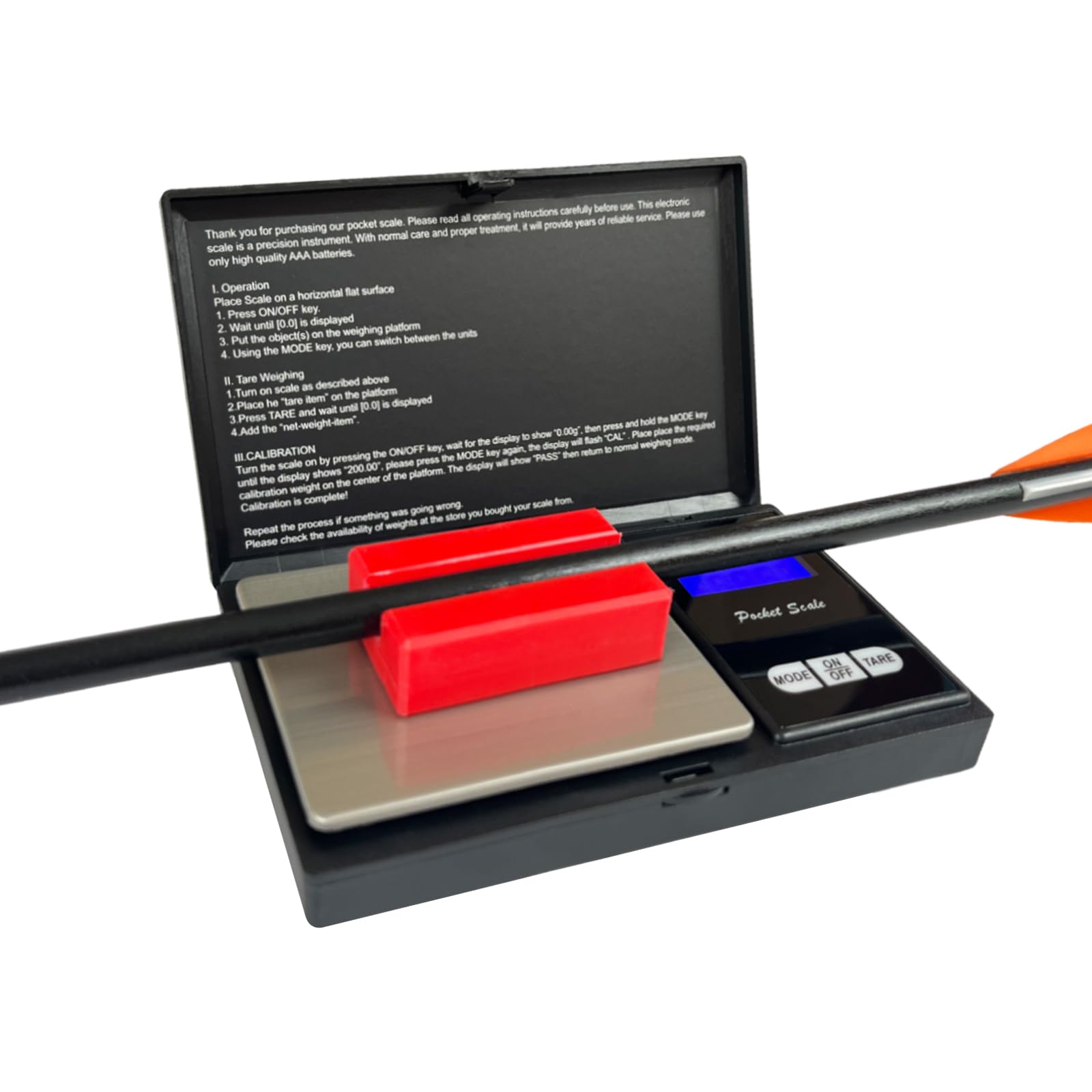
Shop Digital Grain Scales on Amazon →
Why Weight and FOC Pull Against Each Other
Here is the crux most guides skip. The easiest way to raise FOC is to add weight to the front — a heavier point, a brass insert, or a weighted collar. But every grain you add up front also raises the arrow’s total weight, which lowers its speed. And the easiest way to keep an arrow light and fast is to strip weight from the front — which drops your FOC and costs you stability. You cannot freely maximize speed, total momentum, and FOC all at once. Move one lever and at least one of the others responds.
This is why two arrows can weigh exactly the same yet fly completely differently. A 450-grain arrow with a heavy point and a light shaft has high FOC and drives like a nail; a 450-grain arrow built from a heavy shaft with a light point has low FOC and may feel twitchy behind a broadhead. Same GPP, same momentum on paper — very different behavior. Weight tells you how much energy the arrow carries. FOC tells you how that energy is distributed and how the arrow steers. You tune them together or you tune neither.
Momentum, Kinetic Energy, and Penetration
To understand why heavy, forward-weighted arrows penetrate so well, it helps to separate two physics terms archers often blur. Kinetic energy scales with the square of velocity, so it rewards speed and favors light arrows — it’s a decent proxy for how flat an arrow shoots and how much total “work” it can do. Momentum scales directly with mass and only linearly with velocity, so it rewards weight and resists being stopped. Penetration through hide, muscle, and bone is far more a momentum story than a kinetic-energy one.
Add high FOC on top of good momentum and the effect compounds. The forward balance keeps the arrow tracking straight on impact instead of planing or fishtailing, so more of that momentum is delivered in a single, aligned direction rather than bled off sideways. That is the mechanical reason bowhunters chasing large animals favor heavier arrows with 12%+ FOC: not because the number is fashionable, but because a straight-tracking, momentum-rich arrow keeps pushing after the point meets resistance.
Building an Arrow That Balances Both
Tuning weight and FOC together is a deliberate sequence, not a guess. Start from your goal and your draw weight, pick a target total weight in GPP, then decide how much of that mass belongs up front to reach the FOC you want. Because point and insert weight sit at the very tip, they move the balance point far more per grain than shaft or nock weight does — a 25-grain jump at the point buys noticeably more FOC than the same 25 grains spread down the shaft.
Where the Extra Weight Goes
Front weight has three main homes. The point or broadhead is the biggest lever — moving from 100 to 125 or 150 grains adds mass exactly where FOC responds most. Inserts are the second: a standard aluminum insert weighs only a few grains, while a brass insert can add 20–50 grains right behind the point without changing your point choice. Third are weighted half-outs and collars for archers who want to push FOC to the extreme. The trade you accept is speed: every one of these additions slows the arrow, so you balance the FOC you gain against the trajectory you’re willing to give up.
One caution that ties the whole build together: changing point weight also changes how the shaft flexes on release, which is your dynamic spine. A heavier point makes a given shaft act weaker (more flexible). So chasing high FOC with a much heavier point can push you out of proper spine and wreck your tuning. Weight, FOC, and spine are a three-way system — you cannot move one to its limit and expect the other two to stay put.
Shop Brass Arrow Inserts on Amazon →
Matching the Setup to the Shot
The right blend of weight and FOC depends entirely on what you’re asking the arrow to do. A target archer shooting known distances on a calm indoor range can run a lighter arrow with modest FOC — flat trajectory and easy speed matter more than deep penetration into a foam butt. Push that same archer outdoors into gusty field conditions and a bit more weight and FOC starts paying off in wind resistance and consistency.
A bowhunter inverts the priorities. Here total momentum and straight-tracking penetration outrank a few feet per second of speed, so heavier arrows in the 6.5–8 GPP range with 12–15% FOC are common, and broadhead flight forgiveness becomes a real concern that higher FOC directly helps. The 3D shooter splits the difference — enough weight and FOC to hold a group through wind at unmarked yardages, but not so much that the arrow drops off a cliff past 40 yards. There is no single correct arrow, only the arrow correctly matched to the job.

Once you see arrow weight and FOC as two dials on the same machine rather than two unrelated specs, the whole build clicks into place. Weight sets how much energy the arrow carries downrange; FOC sets how that energy is distributed and how honestly the arrow tracks toward the target. Get a grain scale, measure what you actually have, calculate your real FOC, and change one variable at a time. The arrow that results won’t just be numbers on a spreadsheet — it’ll be the one that flies true, hits hard, and forgives you on the shots that aren’t perfect.
Shop Carbon Hunting Arrows on Amazon →
Sources
- Wikipedia — Arrow (components and construction)
- Wikipedia — Momentum vs. kinetic energy
- Easton Archery — arrow specifications and tuning references
- USA Archery — equipment and technique resources
